Posts

The Ascension of Christ

Image
The ascension is perhaps the most overlooked and underappreciated event in the life and ministry of our Lord Jesus Christ. His death and resurrection figure prominently in evangelical preaching, as well they should. But why is so little attention given to the Ascension, especially since the subject is mentioned so frequently in Scripture? Jesus foretold it ( e.g. , Jn. 6:62; 14:12; 16:5ff; 20:17); Mark and Luke record it as a historical event (Mk. 16:19; Lk. 24:50-51; Acts 1:9-11); and both Paul and the writer of Hebrews explain its implications ( e.g. , Eph. 1:20-23; 4:8-10; Phil. 2:9-11; 1 Tim. 3:16; Heb. 1:3; 4:14; 9:24). Why then is such scant attention given to it today? I can only assume it’s because its significance is not well understood. What a pity! There are few things that demonstrate the glory of Christ quite like the ascension. It’s one of the greatest honors the Father has been pleased to confer upon the Son. Luke recounts it briefly: And when he had said these thin...

The Resurrection of Christ and the New Creation

Image
The apostle John begins his account of our Lord’s resurrection by telling us that it occurred on “the first day of the week” (20:1). In fact, all four Evangelists introduce their respective narratives of the resurrection by telling us this. I find this to be very interesting. Rather than emphasizing the fact that it was the third day after the crucifixion, they emphasize that it was the first day of the week. Of course both are true, but it’s the latter they emphasize. I find this interesting because Jesus had said on several occasions that he would be crucified “and after three days rise again” (Mk. 8:31). [1] We might have expected that at least one of the Gospels would have begun the narrative of the resurrection by saying, “Now on the third day after he was crucified…” This would have tied in very nicely with all that Jesus had said beforehand and would have emphasized the fulfillment of his word. But none of them mentions the fact directly, only that it was the first day of ...

The earth shall be filled with the glory of the Lord

I noticed something interesting today in the book of Numbers that I hadn’t seen before (even though I’ve read the book, who knows how many times?), namely, the Lord swears by the fact that the earth will be filled with his glory:  “Truly, as I live, and as all the earth shall be filled with the glory of the L ord …” (14:21). In Psalm 72, we find the idea stated as a petition :  “May the whole earth be filled with his glory!” (v. 19) This is something I find myself praying for on a regular basis. As a petition, it might seem as if there is an element of contingency implied. In Habakkuk, however, we find it stated as a fact:  “The earth shall be filled with the knowledge of the glory of the L ord as the waters cover the sea” (2:14; cf. Isa. 11:9). What is noteworthy in Numbers is the strengthened certainty of the fact by the unique oath formula. It is so certain that the Lord himself swears by it . We frequently find the formula, “As I live, declares the...

Who do you say he is?

At one point during his ministry Jesus asked the twelve, “Who do people say that the Son of Man is?” They reported that some claimed he was John the Baptist or Elijah or one of the other prophets risen from the dead. Then he posed the question directly to them, “Who do you say that I am?” This is THE question in the New Testament—the question of Jesus’ identity. Is he the Christ, the Son of the Living God? Or is he a fraud, an impostor? Or maybe it was as some in his own only family had thought, that he was delusional. There are still many differences of opinion today. Some people say he was an ordinary rabbi who was misunderstood by the twelve; that they made claims for him that he never made for himself; that they put words in his mouth he never spoke; that he never claimed to be the Messiah or the Son of God, but in their zeal for him they made grand and exaggerated claims on his behalf. Some people say that he did in fact make the claims the Bible says he made, but th...

A Prayer for the President

Image
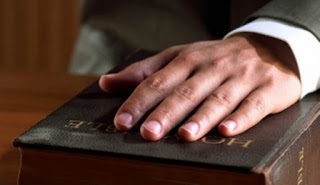
Our Father in heaven, we confess that you alone are God and that all authority in heaven and on earth belongs to you. [1] Your dominion is an everlasting dominion, and your kingdom endures from generation to generation. [2] You change times and seasons; you remove kings and set up kings. [3] You execute judgment, putting down one and lifting up another, [4] and no one on earth wields power without having received it from you. Therefore, we acknowledge that it is by your will that Donald Trump has come to be the president of the United States. We pray that he may recognize this as well and that the thought of it would humble him and cause him to tremble under the weight of so great a responsibility, remembering that he shall one day have to give an account for the sacred trust you have given him. May he see himself as your servant, called to do your will. May he seek you with all his heart, and find you. Hear him, when he prays to you. [5] And please hear us, too, as we pray on...

A man and his oath

Image
“It is not the   oath   that makes us   believe   the   man, but the man the oath.” ~ Aeschylus On Friday Donald Trump will take the oath of office to become the 45 th  president of the United States, bringing unmitigated joy to some and plunging others into deep despair. Judging by social media, these two reactions exhaust the range of possibilities:  there are only lovers and haters. In reality, many find themselves somewhere in between. I feel something like a man who has experienced a narrow brush with death, relieved that the republic avoided the almost certainly fatal wound of a Clinton presidency, and cautiously optimistic that the wound that is Trump, though serious, is curable. As I told my family on election night, “The good news is that Clinton is not president; the bad news is that Trump is .” It turns out that the most beatable Democrat lost to the most beatable Republican. To be fair, I only had two objections to Clinton:...

Suffering and Glory

Image
“The hour has come for the Son of Man to be glorified.” ~ John 12:23 ~ In the fourth Gospel we frequently come across the mention of Jesus’ “hour.” This hour is sometimes referred to by the author (7:30; 8:20; 13:1), but more often by Jesus himself (2:4; 7:6, 8; 12:23; 17:1, 5; cf. 12:27, 28; 13:31). [1] It is said several times over in the first half of the book that his hour had not yet come. But beginning in chapter twelve, his hour is impending. His hour is the time that had been appointed by the Father for his suffering and death, to be followed of course by his resurrection and ascension. In several of these passages Jesus’ hour is mentioned in connection with him receiving glory from the Father (12:23, 27-28; 13:31; 17:1). It is also worth noting that in all these passages Jesus looks past his suffering and death, and looks to receiving glory from the Father. He doesn’t say, “The hour has come for the Son of Man to be crucified,” but “The hour has come for...

On the Virgin Birth

Image
Recently, a popular evangelical preacher, Andy Stanley, dismissed the importance of the virgin birth by claiming that “Christianity doesn’t hinge on the truth or even the stories around the birth of Jesus.” Stanley is the founder of North Point Ministries, a network of six churches in and around Atlanta, attended by 30,000 people each week. In a message he gave on December 3, he said: A lot of people just don’t believe it [i.e., the virgin birth]. And I understand that, and maybe, you know, the thought is, hey, you know, they had to come up with some myth about the birth of Jesus to give him street cred, you know, later on. And maybe that’s where that came from. He stops short of claiming this as his own view. But he goes on to say something which seems to indicate he believes the position has some plausibility: It’s interesting because Matthew gives us a version of the birth of Christ; Luke does; but Mark and John, they don’t even mention it. And a lot has been made ...

"Why lies he in such mean estate?"

Image
This line from the Christmas carol, What Child is This?,  draws attention to the seeming incongruity of the Son of God being laid in a manger. Have you ever considered how the whole narrative of our Lord ’ s birth shows us that  God delights to do great things by humble means?  Think, for example, of this prophecy from the book of Micah, delivered some 700 years before the event: But you, O Bethlehem Ephrathah,            who are too little to be among the clans of Judah, from you shall come forth for me            one who is to be ruler in Israel, whose coming forth is from of old,            from ancient days (Micah 5:2) There are several important truths that can be gleaned from this prophecy, but one that is often overlooked is what it says about Bethlehem itself, namely that it was “too little to...

The Christian Mind in the Christian Life

Image
The apostle Paul speaks a great deal about the importance of the mind in the Christian life. For example, he contrasts the mind set on the flesh with one set on the Spirit. The former, he tells us, leads to death, while the latter leads to life and peace (Rom. 8:5-6). He admonishes us not to be conformed to this world, but to be transformed by the renewal of our minds (Rom. 12:2). Elsewhere he urges us to set our minds “on things that are above, not on things that are on earth” (Col. 3:2). The mind is the Christian’s battleground. What we choose to do with it, how we choose to employ it, determines everything. Sin begins first with the suggestion, proceeds to the imagination, from there to desire, then to the deed, then to the habit, and finally to destruction. We must resist at the point of suggestion. We cannot always prevent the suggestion from arising—whether it arises from the world, the flesh, or the devil is immaterial—but we can (by God’s grace) refuse to entertain it, ref...