Posts

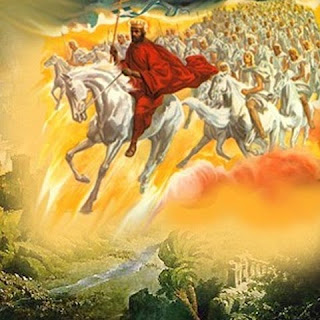
Issues in Bible Prophecy (2): The Gospel Proclaimed to All Nations, the End, and The Coming of the Son of Man
Image
Introduction In my last post , I introduced the subject of Bible prophecy by emphasizing two critically important aspects of it:  timing and historical context.   With regard to timing, we said that if we want to understand the prophecies of the Bible correctly, we must pay close attention to time indicators or time texts. Often, the prophecies of the Bible contain information concerning when the prophecy in question will be fulfilled. Some are very specific: within a year (Isa. 21:16), a little more than a year (Isa. 32:10), in three years (Isa. 16:14), in 40 years (Ezek. 29:11, 13), in 65 years (Isa. 7:8), in 70 years (Jer. 25:11). There are also prophecies with time indicators that are less specific: “in just a little while” (Hos. 1:4); “before your eyes and in your days” (Jer. 16:9), “the days are near,” “In your days” (Ezek. 12:23, 25). These refer to prophesied events that were to take place soon after the prophecies were given. If we should take any of these prophecies...


Issues in Bible Prophecy: Timing and Historical Context

Image
Introduction This is the first in a series of posts on Bible prophecy. In particular, prophecies that are widely thought to refer to the last days (or the end times). In this first post, we’ll consider two issues that are closely related to each other. These are timing and historical context. Timing If we want to understand the prophecies of the Bible correctly, we must pay close attention to the “time texts.” The prophecies of the Bible often contain information indicating when the prophecy in question will be fulfilled. They don’t always do this, of course. For instance, the famous prophecy of Micah concerning the birth of Messiah: But you, O Bethlehem Ephrathah,      who are too little to be among the clans of Judah, from you shall come forth for me     one who is to be ruler in Israel, whose coming forth is from of old,     from ancient days.    ( Micah 5:2) There is no indication in the verse itself, or in the surrounding context as to w...

Reflections on the Sin of Korah

Image
In Numbers 16 we read about a man by the name of Korah, who along with some men from the tribe of Reuben, accused Moses of exalting himself in Israel. “They assembled themselves together against Moses and against Aaron and said to them, ‘You have gone too far! For all in the congregation are holy, every one of them, and the L ord  is among them. Why then do you exalt yourselves above the assembly of the L ord ?” (16:3) It adds an interesting twist to the story when we realize that this Korah was Moses’ cousin. Their fathers were brothers.  The charge that Korah brought against Moses and Aaron had to do with the greater access to God they enjoyed with respect to officiating in the tabernacle. Only they and Aaron’s sons were allowed to serve as priests. Because of this Korah accused them of “exalting themselves above the assembly of the L ord ,” claiming that “all in the congregation are holy, every one of them.” Psalm 106 says, “Men in the camp were jealous of Moses and Aaron, ...

The Lord will Give to Him the Throne of His Father David

Image
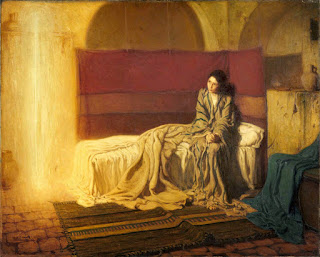
The Annunciation The holy angel who appeared to Mary told her that the Son she was privileged to bear would be great and would be called the Son of the Most High. And he added, “The Lord God will give to him the throne of his father David, and he will reign over the house of Jacob forever, and of his kingdom there will be no end” (Lk. 1:32-33).    Jesus, Son of David That Jesus was descended from David is a point that is frequently emphasized in Scripture and seems to have been widely known, or at least widely suspected by his contemporaries. Some in his day had no hesitation in hailing him as “the Son of David.” Matthew tells us that on one occasion, “two blind men followed him, crying aloud, ‘Have mercy on us, Son of David’” (Matt. 9:27). Even a Canaanite woman, a Gentile, “came out and was crying, ‘Have mercy on me, O Lord, Son of David’” (Matt. 15:22). The crowd that accompanied him during his Triumphal Entry shouted, “Hosanna to the Son of David! Blessed is he who c...

Dear Christian

Image
Dear Christian, It's important for you to know (1) who you are, (2) where you came from, (3) where you're going, and (4) why you're here.   The short answer is, you were made 𝘣𝘺 God and 𝘧𝘰𝘳 God (Rom. 11:36; 1 Cor. 8:6; Col. 1:16). For a more complete answer, read on.   Before the L ord formed you in the womb, he knew you (Jer. 1:5a). He chose you in Christ before the foundation of the world to be holy and blameless before him. In love, he predestined you for adoption (Eph. 1:4-5). He created you in his own image (Gen. 1:27). His hands fashioned and made you (Job 10:8). He formed your inward parts and knitted you together in your mother's womb so that you are fearfully and wonderfully made (Ps. 139:13).   Like a lost sheep, you have gone astray, turning to your own way (Isa. 53:6). You have sinned against him and have fallen short of his glory (Rom. 3:23). Nevertheless, he has loved you with an everlasting love (Jer. 31:3) and sent his only Son into the...

Of What Is, and What Only Seems to Be

Image
Sometimes things happen in life that make it seem as if we are the helpless victims of a cold, dark, impersonal, and merciless fate. The inevitable consequence of such a belief is despair, a point made very poignantly in this medieval poem, O Fortuna, set to music in 1936 by Carl Orff. The video below is a powerful performance. I’ve watched it a dozen times at least in the last six months. If you’ve experienced tragedy and loss, you’ve no doubt felt what it describes, a sense of utter helplessness in the face of forces beyond your control. O Fortune, like the moon you are changeable, ever waxing ever waning; hateful life first oppresses and then soothes playing with mental clarity; poverty and power it melts them like ice. Watch it. Listen to it. Ponder the words carefully. (You can find the full lyrics here ). And then remember that it’s all wrong . There is a vast difference between what is and what only seems to be. In all the fluctuations of life, especially when things turn da...